
Tuesday, June 05, 2007
Why Parapsychology Matters
It's not everyday you'll find an essay about Why Parapsychology Matters in Academia, Science, and Society at a site promoting atheism. I think that this author at atheism.about.com, Austin Cline, is right on in his assertions. See the rest of his essays on parapsychology here.
Sunday, June 03, 2007
ASPS Conference Day 2 Morning Sessions
Although the Academy of Spirituality and Paranormal Studies is not strictly a parapsychological organization, the conference theme, What the Bleep do We Know about Life after Death?, is a question of interest to me and many of my fellow researchers in the field. Even though I didn't always find myself in agreement with the assertions of each and every presenter, it was truly a pleasure to be able to spend a weekend getting out of my own research groove and learning about other people's perspectives on our shared topics of study.
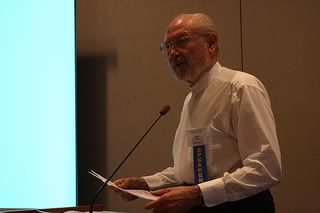 Boyce Batey, the ASPSI Executive director, introduced all of the speakers and kept the conference moving. And let me tell you, he runs a tight ship. So far every single session has begun precisely on time, and most of them have finished on time. During the morning session, Boyce kindly invited me to address the conference for a moment to announce this blog and my other project, OpenSourceScience.net. Thank you, Boyce!
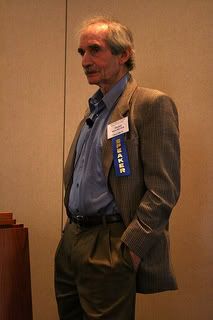 Donald R. Morse, DDS, Ph.D., ASPSI former President, Editor-in-Chief of The Journal of Spirituality and Paranormal Studies, and Professor Emeritus at Temple University opened the morning session with a presentation titled, Can Living a Long, Healthy, Happy, Moral an Spiritual Life Help Pave the Way to a Blissful Afterlife? During his talk, Dr. Morse, a weightlifting champion at the age of 76, spoke about important aspects of health and fitness. As intellectuals with an interest in spiritual matters, I think that researchers such as myself fall at risk of living entirely in our heads. It was refreshing to hear a presenter give consideration to the importance of the body. Following that, he discussed various religious viewpoints on the afterlife, especially in regard to their attitudes toward the human body.
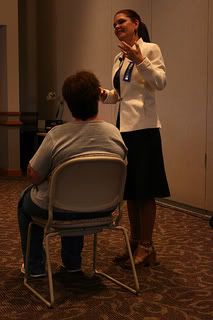 Following that, Karin K. Nemri, ASPSI Secretary/Treasurer, spiritual counselor, hospice volunteer, healer and lecturer shared what she gained from her own near-death experience and her journey to find meaning and purpose in her life. Ms. Nemri also gave a demonstration of a technique she calls 'Aiijii' healing. According to her description, "Spiritual Healers blend into her energy field, take control of her body from the neck down, and physically move her hands and arms to move and blend energy to manifest healing."
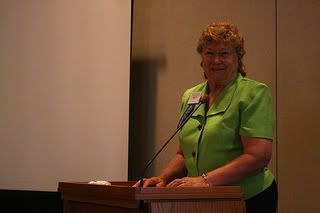 In a similar vein, writer and channeler Betsy Jo Miller spoke of her personal experiences following the death of her son, and presented her channeled material as it related to the conference theme.
Related Posts:
ASPSI Conference Day 1
Boyce Batey, the ASPSI Executive director, introduced all of the speakers and kept the conference moving. And let me tell you, he runs a tight ship. So far every single session has begun precisely on time, and most of them have finished on time. During the morning session, Boyce kindly invited me to address the conference for a moment to announce this blog and my other project, OpenSourceScience.net. Thank you, Boyce!Donald R. Morse, DDS, Ph.D., ASPSI former President, Editor-in-Chief of The Journal of Spirituality and Paranormal Studies, and Professor Emeritus at Temple University opened the morning session with a presentation titled, Can Living a Long, Healthy, Happy, Moral an Spiritual Life Help Pave the Way to a Blissful Afterlife? During his talk, Dr. Morse, a weightlifting champion at the age of 76, spoke about important aspects of health and fitness. As intellectuals with an interest in spiritual matters, I think that researchers such as myself fall at risk of living entirely in our heads. It was refreshing to hear a presenter give consideration to the importance of the body. Following that, he discussed various religious viewpoints on the afterlife, especially in regard to their attitudes toward the human body.Following that, Karin K. Nemri, ASPSI Secretary/Treasurer, spiritual counselor, hospice volunteer, healer and lecturer shared what she gained from her own near-death experience and her journey to find meaning and purpose in her life. Ms. Nemri also gave a demonstration of a technique she calls 'Aiijii' healing. According to her description, "Spiritual Healers blend into her energy field, take control of her body from the neck down, and physically move her hands and arms to move and blend energy to manifest healing." In a similar vein, writer and channeler Betsy Jo Miller spoke of her personal experiences following the death of her son, and presented her channeled material as it related to the conference theme.Related Posts:
ASPSI Conference Day 1
Saturday, June 02, 2007
ASPSI Conference Day 1
Greetings from Center Valley, Pennsylvania!
I'm blogging from the annual conference of the Acadamy of Spirituality and Paranormal Studies (formerly the Academy of Religion and Psychical Research), being held on the beautiful campus of DeSales University. I'm settled into Day 2 of the conference, and playing catch-up with the internet now that I am more coherent after a good night's sleep.
First, let me take a moment to share a personal lesson. I do not recommend to anyone, under any circumstances, that they attempt an 8 hour drive on only 3 hours of sleep. After managing to avoid having my own near death experience, I arrived just in time on Day 1 to grab a bite to eat and listen to Dr. Raymond Moody's keynote address.
The topic of the address was "Near-Death Experiences in Ancient Greek Philosophy: The Origins of Rational Inquiry into the Afterlife." His talk described how the very men who are credited with discovering and developing our current system of reason and logical thinking were concurrently setting the style for rational inquiry into the afterworld. Dr. Moody discussed how figures like Hermotimus, Epimenides, Pythagoras, Heraclitus, Parmenides, Empedocies, Democritus, Socrates, and Plato were also concerned with the phenomena of out of body experiences, near death experiences, channeling and reincarnation. Some of these men were shaman-like figures with visions and experiences of their own to share.
I was very impressed with Dr. Moody's talk, and especially his ease in fielding questions. And Dr. Moody, if you are reading this, please know that the yawning tall blonde in the second row with the watery eyes barely holding up her head throughout your lecture was most definitely NOT bored to tears. She just has time management issues.
Day Two of the conference should appear soon...and with pictures! Stay tuned.
I'm blogging from the annual conference of the Acadamy of Spirituality and Paranormal Studies (formerly the Academy of Religion and Psychical Research), being held on the beautiful campus of DeSales University. I'm settled into Day 2 of the conference, and playing catch-up with the internet now that I am more coherent after a good night's sleep.
First, let me take a moment to share a personal lesson. I do not recommend to anyone, under any circumstances, that they attempt an 8 hour drive on only 3 hours of sleep. After managing to avoid having my own near death experience, I arrived just in time on Day 1 to grab a bite to eat and listen to Dr. Raymond Moody's keynote address.
The topic of the address was "Near-Death Experiences in Ancient Greek Philosophy: The Origins of Rational Inquiry into the Afterlife." His talk described how the very men who are credited with discovering and developing our current system of reason and logical thinking were concurrently setting the style for rational inquiry into the afterworld. Dr. Moody discussed how figures like Hermotimus, Epimenides, Pythagoras, Heraclitus, Parmenides, Empedocies, Democritus, Socrates, and Plato were also concerned with the phenomena of out of body experiences, near death experiences, channeling and reincarnation. Some of these men were shaman-like figures with visions and experiences of their own to share.
I was very impressed with Dr. Moody's talk, and especially his ease in fielding questions. And Dr. Moody, if you are reading this, please know that the yawning tall blonde in the second row with the watery eyes barely holding up her head throughout your lecture was most definitely NOT bored to tears. She just has time management issues.
Day Two of the conference should appear soon...and with pictures! Stay tuned.
Sunday, May 27, 2007
U. Va. article on NDE's
The University of Virginia Magazine has published a very informative and well-written article on the work of the Dr. Bruce Greyson and other researchers at the Division of Perceptual Studies on near death experiences.
Saturday, May 19, 2007
OpenSourceScience.net Seeks Dogs and their Owners
Researchers at OpenSourceScience.net have issued an open call for dogs that know when their owners are coming home.
Many dog owners claim their pets anticipate their arrival by going to wait at a door, window, or driveway. Some claim their dogs do this even when they arrive home unexpectedly, or at odd hours. While some researchers, including Dr. Rupert Sheldrake, a biologist, and former Fellow of Clare College, Cambridge University have investigated this phenomena, many scientists remain unconvinced that it really occurs. Now, a new website located at www.opensourcescience.net is tackling the question though a collaborative efforts of researchers and skeptics.
The researchers are encouraging dog owners who have noticed this behavior in their dogs to take part in the experiments. The original researchers, Dr. Rupert Sheldrake and skeptical scientist Dr. Richard Wiseman, both support this collaborative re-examination of their experiment and have called it, “the best way forward”.
About OpenSourceScience
OpenSourceScience is the first scientifically oriented website to bring the power of open source methods to the skeptical examination of controversial areas of science such as telepathy, psi, parapsychology, near-death experiences, reincarnation, and after-life encounters.
Many dog owners claim their pets anticipate their arrival by going to wait at a door, window, or driveway. Some claim their dogs do this even when they arrive home unexpectedly, or at odd hours. While some researchers, including Dr. Rupert Sheldrake, a biologist, and former Fellow of Clare College, Cambridge University have investigated this phenomena, many scientists remain unconvinced that it really occurs. Now, a new website located at www.opensourcescience.net is tackling the question though a collaborative efforts of researchers and skeptics.
The researchers are encouraging dog owners who have noticed this behavior in their dogs to take part in the experiments. The original researchers, Dr. Rupert Sheldrake and skeptical scientist Dr. Richard Wiseman, both support this collaborative re-examination of their experiment and have called it, “the best way forward”.
About OpenSourceScience
OpenSourceScience is the first scientifically oriented website to bring the power of open source methods to the skeptical examination of controversial areas of science such as telepathy, psi, parapsychology, near-death experiences, reincarnation, and after-life encounters.
Wednesday, May 16, 2007
New Site: Open Source Science
For the past few weeks, Alex Tsakiris (the host of Skeptiko) and I have been developing a new site called OpenSourceScience. The site is the first scientifically-oriented website to bring the power of open source methods to the skeptical examination of controversial areas of science such as telepathy, psi, near-death experiences, reincarnation, and after-life encounters.
OpenSourceScience officially launches its new website located at www.opensourcescience.net today. The website offers a variety of tools for managing scientific experiments and provides a place for visitors to discuss and participate in the research process. Besides promoting scientific collaboration, OpenSourceScience offers financial grants to researchers working within the areas featured on the website.
The site is built on wiki technology, and according to Alex Tsakiris, the open source model is well suited for this task: “The open source model has proven to be a powerful enabling technology because it promotes collaboration. When you look at some of the controversial areas of research, like whether our consciousness is separate from our brain, there has been very little collaboration between researchers and those with opposing views. Everyone seems to agree that collaboration is necessary, but until now, it just hasn’t happened.”
OpenSourceScience is suited for scientifically-minded skeptics as well as those interested in controversial subjects such as parapsychology and human consciousness. The site’s first experiment examines whether dogs can anticipate their owners coming home in a way that is currently unexplained by science. The first two researchers of this phenomena, Dr. Rupert Sheldrake and Dr. Richard Wiseman, have offered their support in this collaborative re-examination of their experiments, and are looking forward to the results. Please join us in our efforts to replicate these studies.
OpenSourceScience officially launches its new website located at www.opensourcescience.net today. The website offers a variety of tools for managing scientific experiments and provides a place for visitors to discuss and participate in the research process. Besides promoting scientific collaboration, OpenSourceScience offers financial grants to researchers working within the areas featured on the website.
The site is built on wiki technology, and according to Alex Tsakiris, the open source model is well suited for this task: “The open source model has proven to be a powerful enabling technology because it promotes collaboration. When you look at some of the controversial areas of research, like whether our consciousness is separate from our brain, there has been very little collaboration between researchers and those with opposing views. Everyone seems to agree that collaboration is necessary, but until now, it just hasn’t happened.”
OpenSourceScience is suited for scientifically-minded skeptics as well as those interested in controversial subjects such as parapsychology and human consciousness. The site’s first experiment examines whether dogs can anticipate their owners coming home in a way that is currently unexplained by science. The first two researchers of this phenomena, Dr. Rupert Sheldrake and Dr. Richard Wiseman, have offered their support in this collaborative re-examination of their experiments, and are looking forward to the results. Please join us in our efforts to replicate these studies.
Friday, May 11, 2007
New Electronic Journal: AntiMatters
There's a new journal developing in the hallowed halls of cyberspace called AntiMatters, and looking at its editorial team, I think it is going to be a promising venture. The focus of AntiMatters is to address issues in science and the humanities from non-materialistic perspectives. The journal is now inviting submissions, and hopes to have its first issue out by August 2007. True to the spirit of the world wide web, the journal "provides immediate open access to its content on the principle that making research freely available to the public supports a greater global exchange of knowledge."
Tuesday, May 08, 2007
This Is London Article
Here's an article in This Is London about current parapsychological research. It's not bad for a press article...I actually learned a couple of things while reading it!


Friday, April 27, 2007
The PEAR lab has closed - an open letter from Jahn and Dunne
Dear PEAR Friend,
As you may already know, the PEAR laboratory program at Princeton University closed its experimental facilities at the end of February. Despite rumors to the contrary, this move was not imposed upon us but was our own carefully considered decision, based on a constellation of relevant factors. We felt that we had accomplished what we originally set out to do 28 years ago, namely to determine whether anomalous consciousness-related phenomena could be studied under rigorously controlled laboratory conditions and, if so, whether they were real and what were their salient characteristics. The enormous databases produced by PEAR have provided clear evidence that human thought and emotion can produce small but measurable influences on physical reality and have established numerous insights into their major correlates. They have also established the basis for several conceptual models that attempt to accommodate the empirical results within a scientific framework. While there are still many important questions to be addressed before we can hope for a full understanding of the nature, function, purpose, and utility of these phenomena, productive further study will require a coordinated interdisciplinary approach to the topic that has not been feasible under the prevailing intellectual and technological constraints of our university environment.
Given the substantial technological, financial, and human resources that would have been required to continue the existing program, we agreed that the most productive and efficient use of our own future efforts would be to provide guidance and encouragement to a new generation of scholars who can extend this study into fresh and more challenging domains of investigation. To this end, we have transferred several pieces of our experimental equipment to a respected colleague at another university, and have been engaged in an extensive archiving program of PEAR's insights and databases. We shall continue to maintain and periodically update the PEAR website, which now includes more than 50 archival publications and reports that can be downloaded from the Publications page and which are indexed in the "Current Web Contents" of Thomson Scientific's ISI Web of Knowledge. We shall also continue to maintain our mailing list and provide information about future publications and activities. Look for an anthology of PEAR publications pertinent to the burgeoning fields of complementary and alternative medicine that will be appearing in a special May issue of Explore: The Journal of Science and Healing, edited by Dr. Larry Dossey.
Our future plans include oversight of the International Consciousness Research Laboratories
We shall also continue to serve as Officers of the Society for Scientific Exploration and encourage you to consider joining that organization if you are not already a member.
Although the era of the PEAR laboratory, per se, has been completed, we look forward to these next chapters of the PEAR saga with considerable enthusiasm. While we take great satisfaction in the intellectual accomplishments of our long-standing research program, we have derived even even greater pleasures from the extensive network of friends and colleagues that our work has attracted, and we thank you most warmly for your continued interest and support.
With kindest regards,
Bob Jahn and Brenda Dunne
Thursday, April 26, 2007
PF Lyceum Blog: Rhea White
Dr. Carlos Alvarado has written a new blog post, In Memory of Rhea A. White: Recollections of a Life in Parapsychology, and Beyond. It's a well-written essay with a lot of great links, so check it out!
Friday, April 20, 2007
Parapsychology Career Project
I received an email from Eric, an 8th grader in Pawtucket, Rhode Island, who is researching the career of a parapsychologist for a school project. Eric has some very good questions about what parapsychologists do for a living, and he is looking for volunteers to address the following:
1. A parapsychologist's daily schedule and responsibilities
2. The educational requirements, training, and certification to become a parapsychologist
3. A ballpark figure of a parapsychologist's salary ranges and benefits
4. An estimated job outlook
5. The importance of this career to life science
If you are a PA member and you would like to help Eric with his school project, please email me at annalisa@publicparapsychology.org and I will put you in touch with him.
1. A parapsychologist's daily schedule and responsibilities
2. The educational requirements, training, and certification to become a parapsychologist
3. A ballpark figure of a parapsychologist's salary ranges and benefits
4. An estimated job outlook
5. The importance of this career to life science
If you are a PA member and you would like to help Eric with his school project, please email me at annalisa@publicparapsychology.org and I will put you in touch with him.
Wednesday, April 18, 2007
Contact Information
Public Parapsychology
P.O. Box 24173
Columbus, OH 43224
U.S.A.
general inquiries: annalisa@publicparapsychology.org
news/announcments: news@publicparapsychology.org
calls for participants: studies@publicparapsychology.org
research summaries: summaries@publicparapsychology.org
reviews: reviews@publicparapsychology.org
P.O. Box 24173
Columbus, OH 43224
U.S.A.
general inquiries: annalisa@publicparapsychology.org
news/announcments: news@publicparapsychology.org
calls for participants: studies@publicparapsychology.org
research summaries: summaries@publicparapsychology.org
reviews: reviews@publicparapsychology.org
Richard Wiseman on Skeptiko
Join host Alex Tsakiris when he interviews psychology researcher and paranormal skeptic Dr. Richard Wiseman about the skeptical community, paranormal research, and quirky psychology.
During the 40-minute interview Wiseman explains what’s lacking in paranormal research and skeptical inquiry: “The public is actually badly served by the science community in that sense. There’s a deep wanting to know what’s gong on from some members of the public … so I think a coming together, where people design experiments, conduct experiments and interrupt them in a collaborative way may be a more constructive way forward.”
He also explains why he’s not convinced all parapsychology research is warranted: “Should we continue looking for these rather strange, bizarre phenomena? My answer to that is quite complicated. It depends on what else we might be doing with our time, and whose paying for it, and so on.
Download the interview with Richard Wiseman here.
During the 40-minute interview Wiseman explains what’s lacking in paranormal research and skeptical inquiry: “The public is actually badly served by the science community in that sense. There’s a deep wanting to know what’s gong on from some members of the public … so I think a coming together, where people design experiments, conduct experiments and interrupt them in a collaborative way may be a more constructive way forward.”
He also explains why he’s not convinced all parapsychology research is warranted: “Should we continue looking for these rather strange, bizarre phenomena? My answer to that is quite complicated. It depends on what else we might be doing with our time, and whose paying for it, and so on.
Download the interview with Richard Wiseman here.
Subscribe to:
Posts (Atom)